Why Text and Image Feel Logical (and When It Doesn’t Work)
One of the most intuitive concepts from this lesson is Dual Coding Theory, which describes how our brains interpret linguistic and visual information via independent but interconnected pathways. This theory immediately connected with my personal learning style. When reading lengthy academic material, I frequently draw symbols, graphs, or simple diagrams beside my notes. I now realize that this innate behaviour is not unintentional; it is the brain’s attempt to disperse cognitive effort over each pathway rather than overloading the spoken one.
Schnotz’s explanation of how learners form mental models from text rather than images shed light on why text-only learning might be demanding. Text demands sequential processing, continuous attention, and interpretation. In contrast, images may transmit structure and relationships very quickly. When these two modes are in sync, they lessen load on working memory while improving understanding. This reinforces Schnotz’s belief that “students usually learn better from words and pictures than from words alone” (2022).
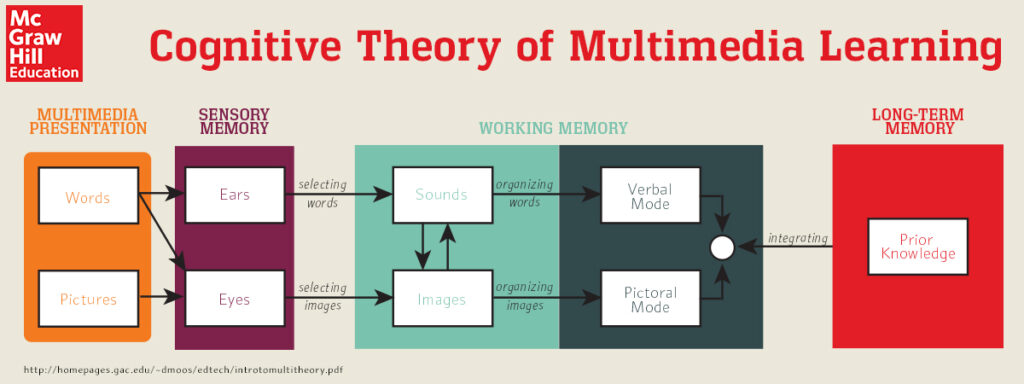
What challenged my ideas was the realization that merging text and image did not necessarily promote learning. Before this module, I thought that adding images was inevitably useful. Mayer’s Redundancy Principle conflicts with this belief. When learners are given the same material in both spoken narration and written text, cognitive resources get lost due to unnecessary redundancy. Instead of increasing comprehension, redundancy adds extra cognitive effort and impedes learning.
This realization has altered how I perceive standard classroom presentations. Slides thick with words that match oral explanations suddenly appear counterproductive rather than beneficial. A more successful strategy is to put visuals or keywords on slides and let narration carry the explanation. This division enables each channel to perform unique cognitive tasks rather than competing for attention.
The usage of memes is a good real-world example of effective dual coding. Memes function because they reduce redundancy: the visual conveys immediate emotional or contextual meaning, whereas the text anchors interpretation. Neither element duplicates the other. Instead, they collaborate to generate meaning fast and effectively.
This lesson reframed multimedia learning for me as a design problem rather than a content problem. The idea is not to add additional elements, but to select the most appropriate combination of elements depending on how the brain processes information. Understanding when images aid and when they hinder has increased my critical thinking skills as a learner and as a teaching resource.
Attached here is a link that summarizes Mayer’s Cognitive Theory of Multimedia Learning.